A look at what "end-to-end encrypted" does and doesn't cover when you're running a business on it
If you're evaluating messaging platforms for your business, you've probably already heard that WhatsApp is end-to-end encrypted. That's true, and it's worth taking seriously — WhatsApp uses the Signal protocol, which is genuinely one of the most respected encryption standards in the industry. We're not here to tell you that part is fake.
What we want to walk through is a narrower, more useful question: encrypted from what, exactly — and what does that leave exposed for a business? Because "end-to-end encrypted" is doing a lot of work in WhatsApp's marketing, and the honest answer is more specific than the headline suggests.
What WhatsApp actually encrypts
Message and call content — the words you type, the things you say on a call — are encrypted in transit using the Signal protocol. WhatsApp's own privacy policy is direct about this: messages are encrypted before they reach WhatsApp's servers, which means WhatsApp cannot read them, and once delivered, they're deleted from WhatsApp's servers entirely. If a message can't be delivered, it sits encrypted on their servers for up to 30 days, then gets deleted. That's a real, meaningful privacy guarantee for message content. We're not disputing it.
What WhatsApp doesn't encrypt — and this is the part that matters for a business
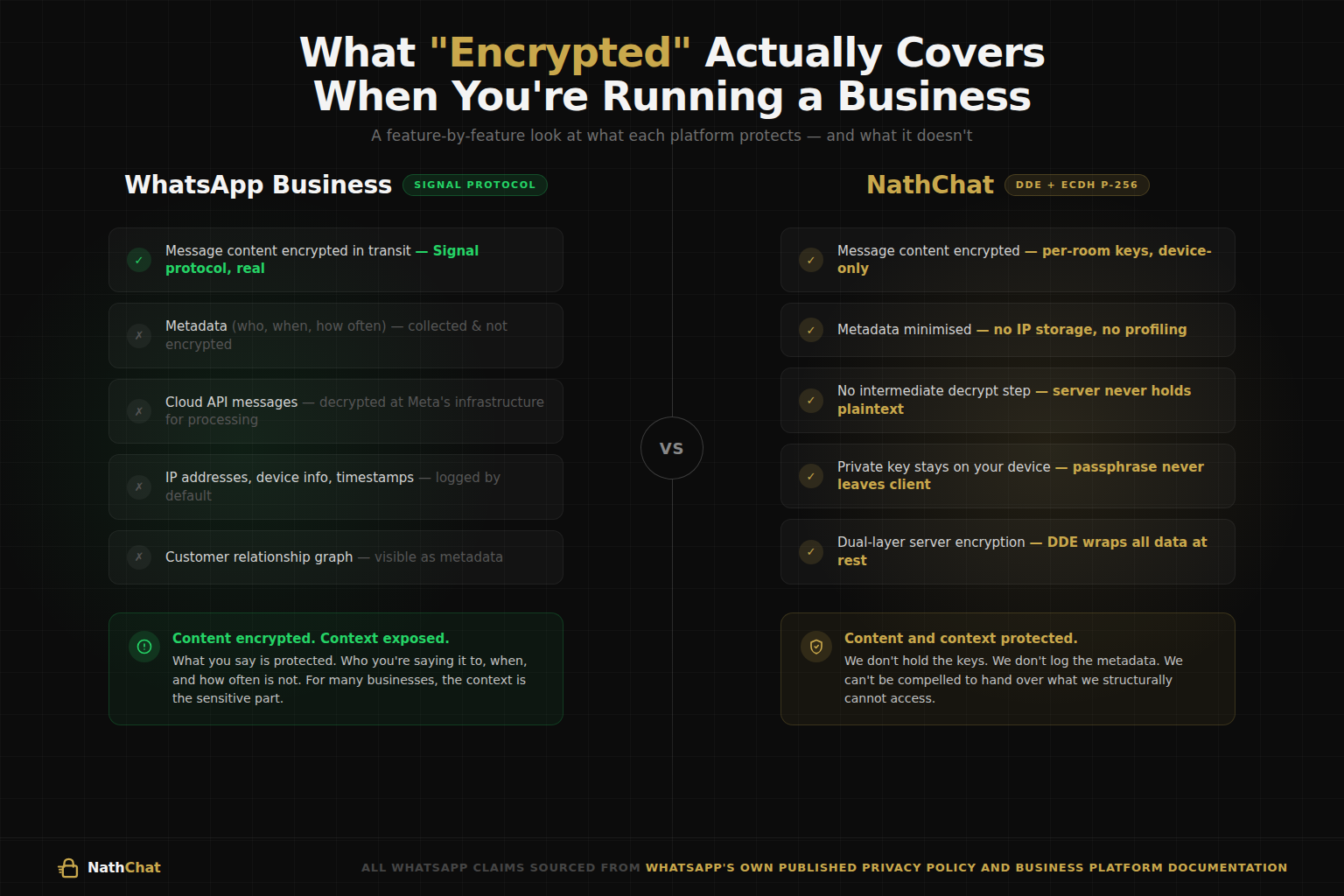
Here's where it gets more specific. WhatsApp's content encryption doesn't extend to metadata — and metadata, for a business, often is the sensitive part. Multiple independent analyses of WhatsApp's privacy model converge on the same point: metadata such as who you communicate with, when, how frequently, your phone number, device information, general location via IP, and group affiliations is collected and is not encrypted the same way message content is. For a business, think about what that metadata actually reveals: which customers you're talking to, how often, when your busiest support hours are, which leads you're actively working, and the shape of your entire customer relationship graph — all visible as metadata, independent of what's actually said in any individual message. This isn't a secret or a gotcha. WhatsApp's own privacy policy is explicit that it collects usage and log information, including activity, settings, interactions, and the time, frequency, and duration of your communications. It's published, it's disclosed, and it's also exactly the kind of operational intelligence a business might not want sitting on a platform's servers.
WhatsApp Business specifically — the part that changes everything
The picture shifts further once you're using WhatsApp Business or the Cloud API rather than the consumer app. WhatsApp Business Platform documentation describes the Cloud API as hosted by Meta, with messages decrypted by the Cloud API for processing and re-encrypted before reaching the business. That's a meaningfully different model from peer-to-peer end-to-end encryption — the message passes through a decrypted state at Meta's infrastructure layer as part of normal Cloud API operation. WhatsApp's own Business Platform messaging is also clear that when businesses choose to share information with Meta, or work with business solution partners for hosting and chat management, Meta may receive certain information — though message and call content itself is stated as not shared with Meta in that context. Worth noting too: in early 2026, a complaint was filed alleging Meta retained and accessed business conversations beyond what encryption should have allowed. Meta has firmly denied this, and respected cryptographers including Matthew Green have pointed out that the underlying Signal protocol architecture is specifically designed to prevent exactly that kind of access. We're not taking a position on an active, disputed legal matter — but the fact that the question is being litigated at all says something about how much trust in this space still rests on taking a company's word for how its systems behave internally, rather than on an architecture where the question simply can't arise.
How NathChat is built differently
We don't process your messages through any intermediate layer, decrypted or otherwise. Every conversation on NathChat has its own encryption key, generated and exchanged directly between participants' devices. Your private key is derived from a passphrase that never leaves your device — we don't receive it, store it in usable form, or have any technical mechanism to reconstruct it.
That's not a policy commitment we're asking you to trust. It's an architectural fact you can verify: there is no point in NathChat's infrastructure where a plaintext message, a usable private key, or a usable room key exists on our servers. Not during normal operation, not during business onboarding, not during a server breach. We wrote in detail about exactly how this works in [an earlier post](#) if you want the full technical breakdown. On metadata specifically — we don't store IP addresses. We don't build behavioral profiles. We don't collect device fingerprinting beyond what's strictly necessary for account security. Our minimal data collection isn't a feature we bolted on for this comparison — it's how the platform has worked since before any of this was public.
What this means if you're choosing a platform for business
If your business deals in routine, low-sensitivity customer chat — order confirmations, general support questions, marketing opt-ins — WhatsApp's model is mature, widely adopted, and your customers are probably already comfortable using it. That's a real advantage, and we're not going to pretend reach and familiarity don't matter. If your business handles conversations where the fact that you're talking to someone is itself sensitive information — legal consultations, healthcare-adjacent communication, financial advisory, journalism, HR and whistleblower channels, or anything where customer relationship metadata could expose competitive intelligence or breach a duty of confidentiality — the gap between "message content is encrypted" and "the platform doesn't know who you're talking to" becomes the actual question worth asking. That second category is who we built NathChat for.
The honest summary
WhatsApp's encryption of message content is real and well-engineered. What it doesn't cover —
metadata, and in the Business/Cloud API context, a decrypt-and-reprocess step at Meta's
infrastructure — is also real, and disclosed in WhatsApp's own documentation if you read past
the headline claim.
NathChat is built so that neither message content nor the metadata of who's talking to whom
exists anywhere we could access it, by design, not by policy. For some businesses that
distinction won't matter much. For others, it's the entire decision.
Curious how NathChat's encryption architecture works under the hood? Read our breakdown of Why your passphrase never leaves your device, Inside NathChat's end-to-end encryption architecture — and why we built it this way., or reach out to our team for a technical walkthrough.