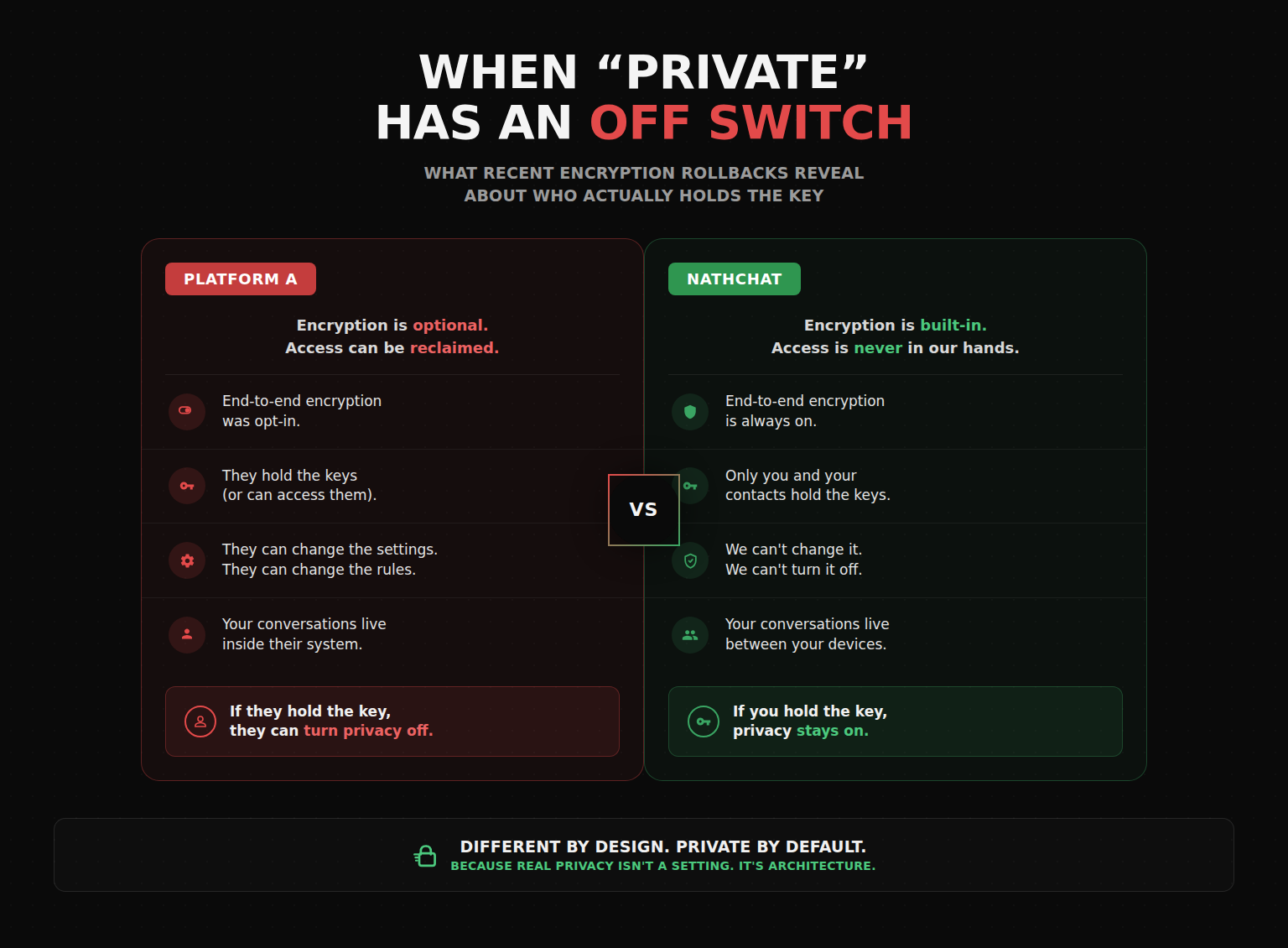
What Instagram's encryption rollback reveals about who actually holds the key
On May 8, 2026, Instagram turned off end-to-end encryption for direct messages. If you had it
enabled, your conversations are no longer protected the way they were the day before. Meta can
now access message content it could not access previously. That's not speculation — it's the
company's own explanation for the change.
We're not writing this to pile on. Building encrypted infrastructure at Meta's scale is
genuinely hard, and we don't think every company that struggles with that challenge deserves
mockery for it. But this moment is worth sitting with, because it reveals something important
about a question every messaging platform eventually has to answer honestly: when a company
says your conversations are private, what's actually backing that promise?
What happened
Instagram's end-to-end encryption for DMs was never the default. It was an opt-in setting,
buried a few taps deep, that most users never found or enabled. Meta announced earlier this
year that it was discontinuing the option entirely, and as of May 8, anyone who had it turned
on lost that protection. Affected users were told to export their message history before the
feature disappeared.
Meta's stated reason was straightforward: very few people were using it, and removing it
allows the platform to better detect harmful content — including material related to child
safety — that encryption had made invisible to their systems. The timing also lined up closely
with a U.S. legal compliance deadline requiring platforms to be able to act on certain reported
content within 48 hours, something that's structurally difficult to do with content you cannot
see.
Privacy organizations pushed back hard. Years earlier, Meta had publicly committed to
encrypting Messenger and Instagram DMs by default, describing it as essential to giving people
"a trusted private space that's safe and secure." That commitment didn't fully materialize, and
now even the limited version of it is gone.
The part that matters more than the headline
Here's the detail worth sitting with: Meta could remove this feature because Meta controlled
it.
That's not a criticism specific to Meta — it's true of how most "encrypted" platforms are
built. If a company's infrastructure is capable of holding the keys, or capable of being
modified to hold the keys, then encryption is a setting. Settings can be changed. Features can
be deprecated. Defaults can be flipped. The promise of privacy lives inside a system the company
fully controls, which means the promise is only as durable as the company's current incentives,
legal pressures, and product roadmap.
This isn't a flaw in execution. It's a structural property of the architecture. A platform that
*can* turn off encryption is a platform that might, someday, for reasons that seem reasonable
at the time — a safety initiative, a legal requirement, a product simplification. The
willingness to do so isn't really the question. The capability is.
What we built differently
We wrote last week about how NathChat's encryption actually works, so we won't repeat the full
technical breakdown here. But the relevant point is this: NathChat is not capable of doing
what Instagram just did, even if we wanted to.
When you set up NathChat, your device generates a private key that's encrypted with your
passphrase before it ever leaves your browser or app. We never receive your passphrase. We
never receive your private key in usable form. Every conversation has its own independent
encryption key, shared directly between participants' devices using each person's public key —
not brokered through a master key we hold.
There is no setting on our end that turns this off, because there is no central place where
"on" and "off" could even live. Removing end-to-end encryption from NathChat wouldn't be a
product decision. It would require rebuilding the entire system from scratch, because the
current one was built specifically so that we never hold what would be needed to read your
messages in the first place.
We're not saying this to claim moral superiority. We're saying it because it's a meaningfully
different category of promise. One is a policy. The other is math. Policies can change with a
press release. Math doesn't.
Why this distinction is becoming more important, not less
Governments around the world are increasingly asking platforms to provide some form of access
to message content — for child safety, for law enforcement, for content moderation at scale.
Some of these requests come from genuinely important concerns. Reasonable people land in
different places on how to balance privacy against those concerns, and we're not going to
pretend that's a simple question with one obvious answer.
What we do think is worth being honest about: a platform that holds the technical capability to
provide access will eventually face real pressure to use it, regardless of what its current
privacy policy says. A platform that genuinely does not have that capability has a different,
simpler answer — not because it's taking a political stand, but because there's nothing to
hand over.
That's the position we've built NathChat to be in. Not because we're certain we'll never face
pressure to change it — every company in this space eventually does — but because changing it
would mean tearing down the architecture and starting over, in full view of everyone watching,
rather than quietly flipping a switch in a settings menu.
If you're moving your conversations somewhere
If Instagram's change has you thinking about where your private conversations actually live,
that's a reasonable moment to ask the question this whole industry would rather you not ask
too closely: *does this platform hold your keys, or do you?
We'd encourage you to ask that question of any platform you use — including us. Read how the
encryption actually works, not just whether the word "encrypted" appears on the page. We've
published the details of how NathChat's works specifically so that question has a real answer,
not a marketing one.
Curious how NathChat's per-room encryption and key architecture works in detail? Read our
previous post on the subject, or reach out to our team — we're glad to walk through the
cryptography with anyone who wants the full picture.